
BOP Loudon Release Coverage
The Federal Bureau of Prisons runs a national prison system. It does not operate the Loudon County Detention Facility, and the official sweep found no federal prison physically located in Loudon County. The BOP path belongs only to a person committed to federal prison. A local LCSO record that names a federal transfer or hold is the bridge to that system. Disappearance from the county roster, standing alone, cannot establish federal custody or a community release.
Federal pretrial custody often belongs to the U.S. Marshals Service. People may be housed at contract facilities while a federal case proceeds. Some never develop a conventional BOP imprisonment result. In those cases, the federal docket, counsel, clerk, or official USMS inquiry route may show detention or bond orders, while the actual custodian confirms physical movement. The county record, federal court record, USMS custody, and BOP prison record answer different questions.
| Federal stage | Primary route | What it can establish |
|---|---|---|
| Loudon jail handoff | LCSO custody record | Local release or receiving agency |
| Federal pretrial detention | USMS, court, counsel | Detention order and custodian route |
| Federal prison term | BOP Inmate Locator | Institution or reported release information |
| Detailed prison release record | BOP FOIA | Existing agency documents subject to law |
Search BOP Release Records
The official BOP Inmate Locator supports a search by BOP Register, DCDC, FBI, or INS number. A number is the best match when known. A name search can use first, middle, and last name with demographic fields. Compare the register number, age, race, and sex rather than accepting the first same-name result. BOP describes the locator as covering federal inmate records from 1982 forward. Older federal prison records use the National Archives route explained by the agency.
A result can show the person’s name, register number, age, race, sex, current location, or release information. Record the exact status and date. “Released” or a past release date with no institution means BOP reports that the person is no longer in BOP custody. That statement is narrow. It does not answer whether another agency received the person or whether federal court supervision continues.
- Choose a federal identification-number search when possible.
- Use name and demographics when no number is known.
- Match the register number and identity fields.
- Record the exact location, wording, and release date.
- Check USMS or the court when the person was pretrial.
- Use BOP FOIA for an existing detailed prison record.
Note: A federal search is appropriate only when a federal record or documented transfer supports that custody path.
Interpret BOP Release Results
BOP’s locator record explanation distinguishes several outcomes. “Released” reports the end of BOP custody reflected in the locator. “Unknown” means the term or release date has not been determined. “In Transit” can mark movement under U.S. Marshals authority and may also appear in a court-release situation where BOP did not receive later designation data. First Step Act calculations and other lawful changes can move dates. Each label must be preserved instead of translated into a more definite claim.
| BOP wording | Careful reading |
|---|---|
| Released or past release date | No longer in BOP custody as BOP reports |
| Current institution | Still assigned within the federal prison system |
| Unknown | Term or release date not yet determined |
| In Transit | Movement or unresolved designation, often involving USMS |
| No matching result | Not proof of release or absence from all custody |
A federal supervised-release term is administered through the federal courts and Probation, not through ongoing BOP incarceration. A person can therefore be outside a prison and still have court-ordered supervision. Conversely, a person absent from BOP may be in USMS, state, county, or ICE custody. The result identifies one system only.
Confirm a BOP Release
Begin with the sending record. If LCSO documents a transfer to federal authorities, preserve the date and named receiver. Then search BOP if the person was committed to federal prison. Match the locator result to the person and read the exact release field. When the federal case was pretrial or the locator is incomplete, use the U.S. Marshals prisoner inquiry guidance and the federal court record. The public should use the appropriate official route rather than expect a general USMS roster.
A release date is stronger when paired with the method and receiving-party information. BOP form BP-A0714 illustrates those distinctions. It can record the date and method of release, transportation, release to a detainer or receiving party, supervision jurisdictions and contacts, and reporting instructions. A detainer entry documents a transfer, not a community-release certificate. The same principle applies to a Loudon County handoff.
The broader Loudon County released-person route helps connect LCSO, TDOC, BOP, USMS, and ICE without blending their records.
BOP Release Record Contact
No Loudon County BOP facility address or local BOP contact exists in the research because no federal prison was identified in the county. The correct contact depends on the task. Use the national locator for public custody or release information. Use the federal court or USMS for a pretrial person. Use the BOP Freedom of Information Act route when an existing, more detailed prison record is needed.
Federal Bureau of Prisons System
Physical Loudon County facility: None identified
Public search: BOP Inmate Locator
Detailed record: BOP FOIA
Federal pretrial route: U.S. Marshals Service or federal court
The BOP FOIA page explains the detailed-record request channel. Identify the person by register number and name, then specify the existing document or release information sought. Do not ask BOP to reconstruct an LCSO booking or a federal court order. Those records remain with the agency or court that created them.
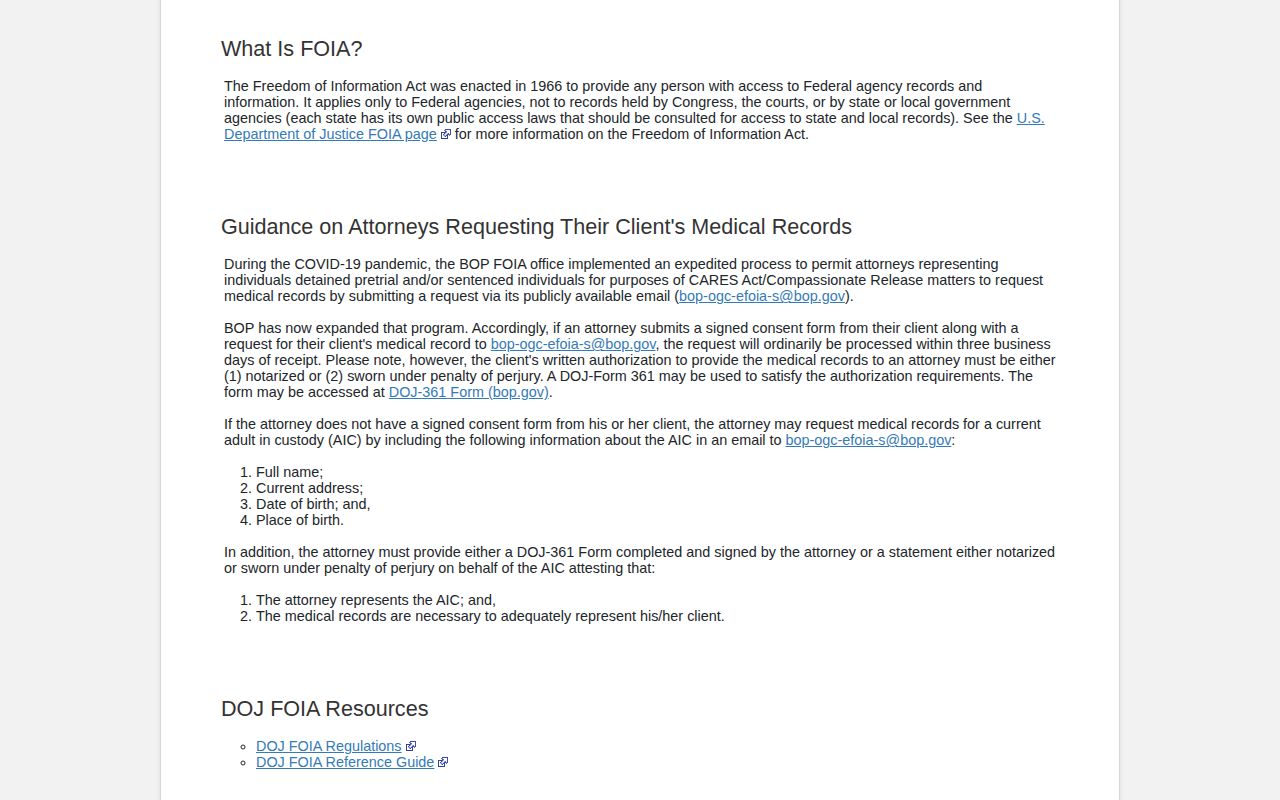
The captured BOP page confirms that a detailed record request is distinct from the quick public locator result.
BOP Locator Release Guidance
BOP’s communications guidance describes what the inmate locator is designed to cover. It is the first public check for a sentenced federal prisoner, not a substitute for every federal custody source. Consult the official locator coverage guidance before treating an empty or unclear result as conclusive.
When a person never reached a BOP institution, the lack of a conventional prison record is expected. Check the federal docket for bond or detention orders and use counsel, the clerk, or USMS for the physical-custody question. A court order can show legal authority, while the custodian confirms the movement itself.
Federal Release Record Boundaries
The county, state, federal, and immigration systems do not merge into one locator. LCSO documents the Loudon jail event. TDOC FOIL documents Tennessee felony custody and supervision. BOP documents sentenced federal prison custody. USMS and federal court sources matter before BOP commitment. ICE documents immigration detention. Search the system supported by the case and transfer record.
- BOP custody
- Confinement within the federal prison system.
- USMS custody
- Federal custody commonly tied to pretrial detention and transport.
- Supervised release
- Federal court supervision after prison, distinct from BOP incarceration.
- Detainer
- A request that another authority receive or hold the person.
A missed result can stem from name variation, pre-1982 coverage, pretrial custody, transfer, or a different sovereign’s system. It cannot prove community release. Match exact identifiers and follow the custody handoff.
BOP Release Proof Sequence
The most reliable federal sequence starts with the local custody record, moves to the federal prison locator when appropriate, and ends with a detailed record or federal court source when needed. Preserve the exact dates and labels at each step. A local release date is the end of LCSO custody. A BOP release date is the end of BOP custody as reported. Neither date alone establishes what happened in every other system.
If the BOP result says Released, check whether the federal court imposed supervised release. If a BOP form or record names a detainer or receiving party, continue with that custodian. If the result says In Transit or Unknown, do not replace it with a guessed date. If no record appears and the person was a federal defendant, return to USMS and the court.
This evidence chain answers the core questions without inventing a Loudon County federal prison. It shows where someone went after leaving the county jail, whether BOP later reported release, and which agency holds the next record.
Keep the register number with the result because it separates people who share a name. When the local transfer date and federal record do not align, ask each originating office about its own entry. One agency should not be asked to correct a date created by another custodian.