
Loudon Parole and Probation Compared
Parole and probation both allow a person to live in the community under rules, yet they start in different places. The Tennessee Department of Correction release descriptions define parole as a Board-approved way to serve part of a prison term in the community. A person does not leave prison merely because the Board voted to grant parole. TDOC must approve the release plan, required steps must be complete, and a release certificate must issue. Probation comes from the sentencing court. It can replace a prison term or follow a jail term in a split sentence.
For a Loudon County case, the source matters. A court judgment shows that probation was ordered. Tennessee FOIL shows a public supervision status and assigned location for people in the state felony system. The Board record shows a parole decision, while TDOC status and the certificate show whether release was carried out. A county jail roster only answers present jail custody. It does not prove that supervision began or ended.
| Point | Parole | Probation |
|---|---|---|
| Legal source | Tennessee Board of Parole decision | Sentencing court order |
| Custody path | Follows state imprisonment | May replace prison or follow split confinement |
| Public verification | FOIL status, assigned location, Board result, and release certificate | Judgment plus FOIL status and assigned location when TDOC supervises |
| Completion | Discharge after the supervised term and governing conditions end | Discharge or court completion under the sentence |
- Parole
- Community service of part of a prison sentence after Board approval and actual release.
- Probation
- A court-ordered community sentence, sometimes imposed after a short jail term.
- Discharge
- The formal end of custody or supervision, not merely a move out of a jail or prison.
- Detainer
- A custody claim by another agency that can turn a release into a transfer.
Verify Loudon Post-Release Supervision
The public starting point is TDOC Felony Offender Information Lookup, known as FOIL. It covers current and former Tennessee felony offenders in TDOC custody or supervision. It does not cover every person booked in Loudon County. Someone who left the county jail after a local misdemeanor, dismissal, or bond may have no FOIL record. Use a TDOC or State ID when available because it reduces the risk of choosing a same-name result.
- Search FOIL by TDOC ID, State ID, or the person's exact first and last name. Use the alias choice only when supported by known facts.
- Match the result with stable identifiers and biographical details. Do not rely on a photo or name alone.
- Open the detail record. Read Supervision Status and Assigned Location together, then note active sentences and sentence dates.
- If the status says Parole or Probation, contact the assigned TDOC field office. Ask the office to confirm what it may lawfully disclose about the assignment.
- For probation ordered in a Loudon case, obtain the judgment or probation order from the correct local court clerk. Pair that order with the current TDOC record.
A result marked Inactive generally points to completed TDOC custody and supervision, but it does not explain every later court event or new hold. A blank location or no search result does not mean the person absconded. The Loudon County released-inmate search paths explain how a local jail record and court order fill gaps when FOIL is not the right system.
Note: Record the agency and retrieval time because supervision, custody, and assigned-office data can change after a new event.
Loudon Supervision Office Assignment
Loudon County is part of TDOC District 21. The official directory lists a Blount/Loudon field office in Maryville. This is the most relevant local contact when a matched FOIL record points there. It is not the Loudon County jail, and it is not the Board of Parole hearing office. The person's Assigned Location controls. Another location in FOIL should be followed even when the underlying criminal case began in Loudon County.
TDOC Blount/Loudon Field Office
304 Home Avenue
Maryville, TN 37801
Phone: 865-981-2360
Fax: 865-981-4515
The official TDOC directory screenshot below shows the District 21 route and helps distinguish supervision districts from prisons. A field-office assignment points toward community oversight. An institutional assignment points toward custody. If those signals conflict, ask TDOC before treating the person as released. The directory provides a sound starting point, but the person-specific FOIL record still decides which office should be called.
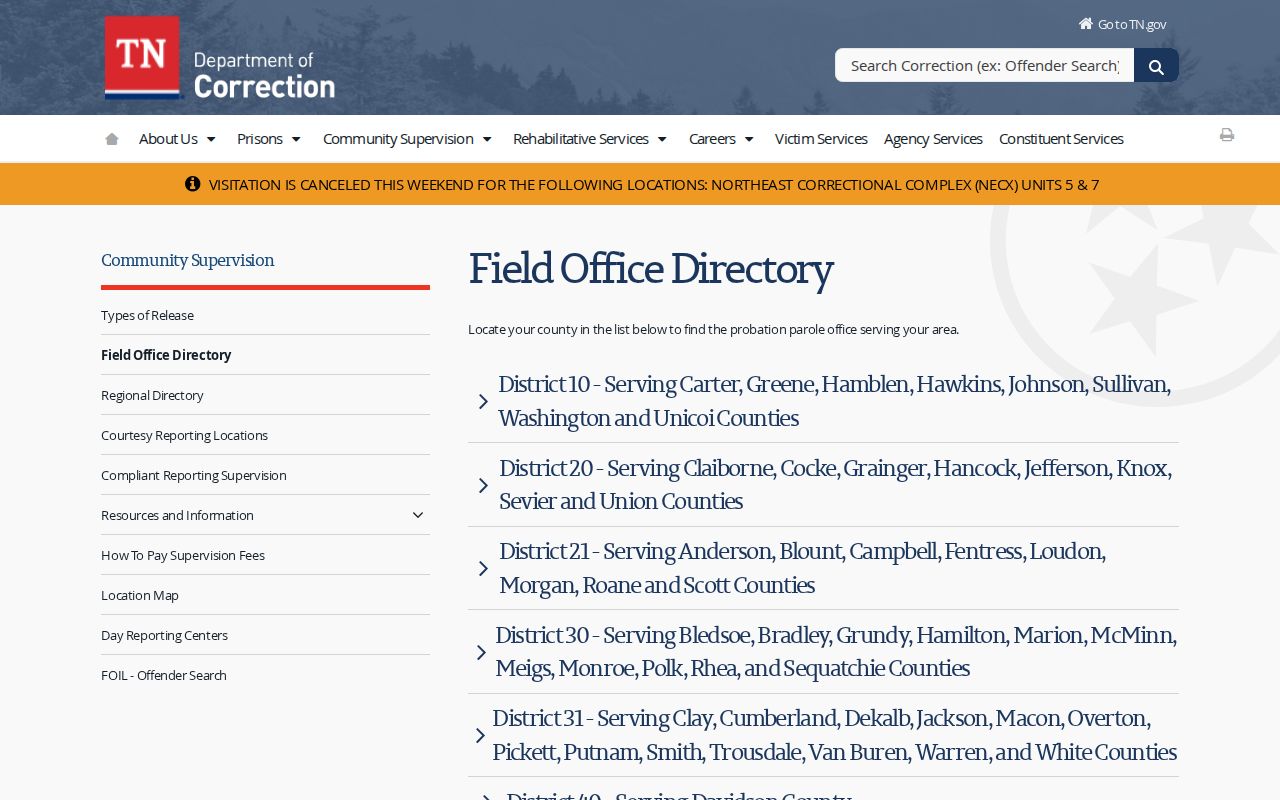
That office listing confirms the Blount/Loudon contact without turning it into a universal reporting location for every person tied to Loudon County.
Loudon Parole Decisions and Release
A scheduled hearing is not a release date. The Tennessee Board of Parole conducts hearings and makes decisions, while TDOC keeps custody and executes release. The Board hearing schedule page is prospective and warns that schedules can change. A listed hearing may be postponed, continued, or followed by a denial, deferral, or grant. Even a grant remains one part of the process.
FOIL can show a Parole Hearing Result. That field proves what the public record reports about the decision. It does not prove that the person walked out. The next steps can include required programs, approval of a community release plan, and issuance of a certificate. Strong proof of actual post-release supervision combines the favorable decision with FOIL community status, an assigned field office, and the release certificate or custody event.
Board Operations maintains hearing files and uses its Certificate Unit when a parole release is carried out. Formal review and appeal rules are narrow. They are not a new hearing on request. The public decision path should therefore stay in order: planned hearing, final vote, approved plan, certificate, physical release, then community supervision.
Note: A Release Eligibility Date permits consideration under governing law; it does not promise release on that day.
Loudon Supervision Violations and Warrants
Supervision conditions are the rules attached to parole or probation. They can include reporting, approved residence or travel, lawful conduct, and program duties set by the proper authority. A violation is an alleged breach of those rules. An absconder is a person alleged to have stopped reporting or otherwise left supervision without permission. Neither label should be inferred from a missing web result.
No official public statewide TDOC absconder list was identified in the Loudon research. FOIL may show status and custody level, but Inactive, a blank location, or a failed name search does not establish a warrant. A supervision violation warrant is handled through TDOC, law enforcement, and the proper court or Board process. Confirm the matter with the assigned field office and the office that issued the warrant. VINE can report custody events for a matched record, but it is not a supervision warrant index.
If a violation causes jail custody, the current Loudon County jail view may show present detention. That current listing answers custody at that time, not the final result of the violation case. A later disappearance can mean release, transfer, or a portal update. Ask the holding agency for the event and destination.
Loudon Release Resource Center Limits
TDOC says its Community Resource Centers can help people on community supervision and people released after sentence expiration navigate services. Day Reporting Centers have narrower eligibility tied to supervision and assessed program needs. No Loudon-specific Community Resource Center or Day Reporting Center was identified in the official source sweep. The statewide resource-center directory is therefore a route to confirm available services, not proof that a Loudon walk-in center exists.
This difference matters after release. The Blount/Loudon field office verifies a supervision assignment. A resource center addresses service navigation. A Day Reporting Center provides structured programming for eligible people. None replaces the court clerk, jail records office, or Board file when the question is whether release happened or why supervision began.
Start with the assigned officer or office when FOIL shows active supervision. Ask which approved resource route fits the person's status. Someone released at sentence expiration may be eligible for some resource-center help without being on parole or probation. That person should not be described as supervised unless the official record says so.
Loudon Release Documents and Property
TDOC describes a state-prison release process that provides key documents, including state identification and birth certificates. That policy is useful for a person leaving a Tennessee prison. The Loudon research did not find an equivalent published LCSO policy for adults leaving the county jail. A county release should ask the jail what property and documents are returned, what must be claimed, and which office handles a missing item.
The distinction tracks the custodian. TDOC controls its prison release process. LCSO controls a county-jail discharge. A Tennessee driver-services locator lists a Loudon County Clerk kiosk at 101 Mulberry Street, Suite 200, Loudon, but the user must confirm that the kiosk performs the exact credential task needed. A kiosk listing alone is not a promise of replacement service.
Document help also does not prove release. Use the custody record, FOIL status, and assigned location for that question. Once release is confirmed, the responsible agency can explain its own document and property process. This keeps a Loudon County jail release separate from a TDOC prison discharge.
Note: Ask the releasing agency about property before visiting another office, since county and state release practices are not interchangeable.
Loudon Supervision Discharge Records
Supervision ends through a formal discharge or other lawful case action, not merely because reporting seems to stop. For a TDOC case, FOIL marked Inactive with no active Tennessee sentences is the strongest public sign that state custody and supervision ended. A formal need calls for TDOC confirmation. For court probation, obtain the discharge, completion entry, or later order from the sentencing court.
Keep four events separate: release from jail, release from prison, service of a sentence in the community, and final discharge. A person can be outside a cell yet remain on parole or probation. Another person can finish a county sentence with no TDOC supervision at all. The right record depends on which event must be proved.